
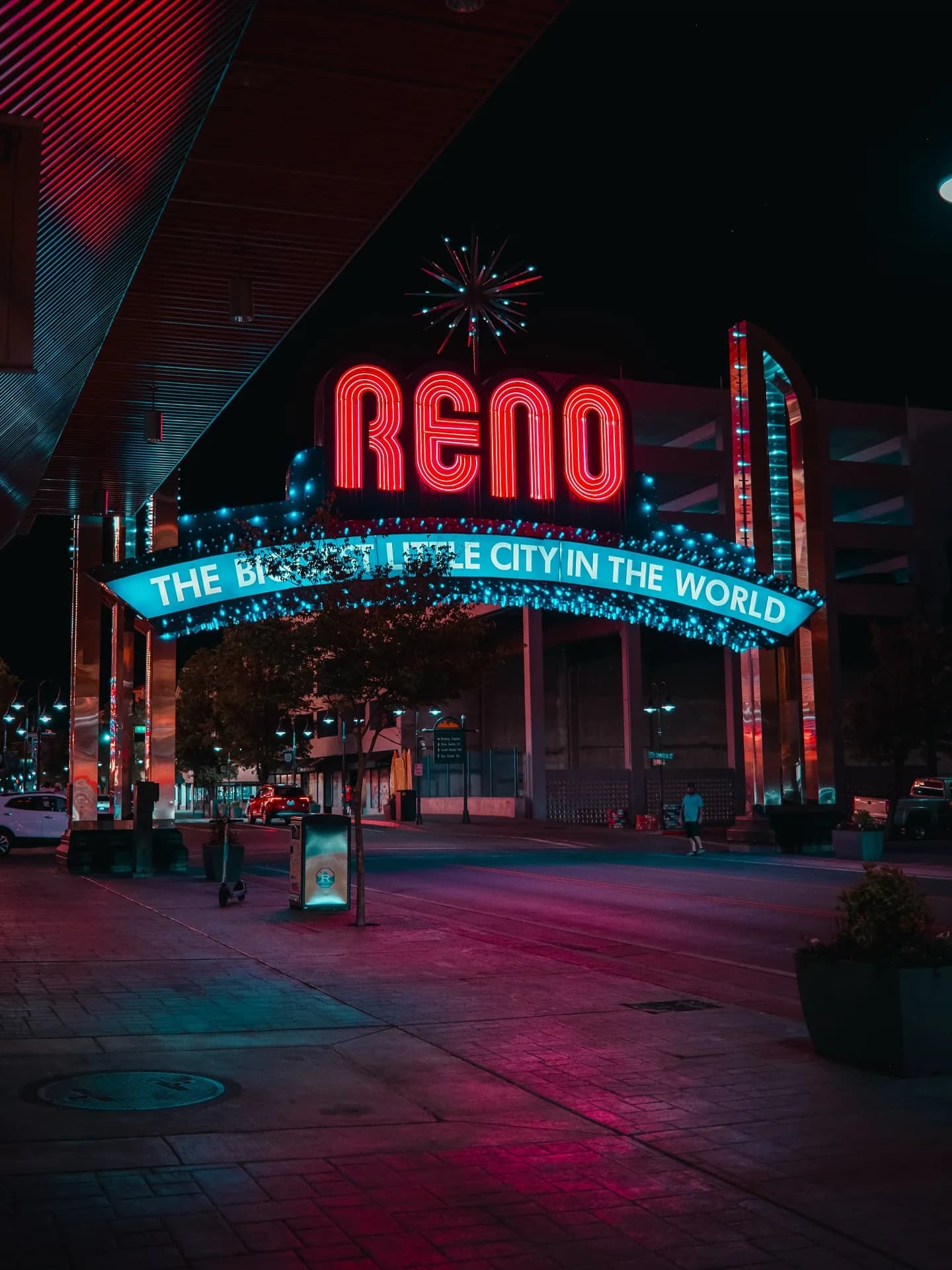

If you own property in downtown Reno, Sparks, or Incline Village, understanding the local short-term rental regulations is essential before listing on Airbnb or any other platform. This guide covers everything you need to know, updated for 2026.
In short
- Which rules apply depends on which jurisdiction the parcel physically sits in, not on the mailing address. Parts of Spanish Springs and Sun Valley carry city-style addresses but sit in unincorporated Washoe County, where the full county permit program applies.
- The City of Reno has no short-term rental permit program. Its land development code creates no short-term rental use, and the city's own business-licensing page lists vacation rentals and short-term rentals as exempt from a city business license.
- In unincorporated Washoe County, including Incline Village and Crystal Bay, a county permit is required before advertising or renting for under 28 days, and permits must be renewed every year. The county states plainly that a property inside Reno or Sparks cannot obtain one.
- A transient lodging tax license from the RSCVA is required everywhere in Washoe County, cities included. It is free, and operating without one is unlawful.
- In unincorporated Washoe County a designated local responsible party who can respond quickly to complaints is a core permit requirement, and the reason remote self-management is hard there.
- An HOA can prohibit short-term rentals even where the city or county allows them: a permit never overrides CC&Rs.
Quick Reference
- No city STR permit
- Exempt from city business license
- RSCVA room tax license required
- No published city STR permit
- RSCVA room tax license required
- Confirm with city before listing
- County STR permit required
- RSCVA room tax license required
- Includes Incline Village
City of Reno: STR Regulations
This is the section most owners get wrong, and it is worth reading slowly, because almost every “Reno short-term rental permit” article online is actually describing Washoe County's program, which does not apply inside the city at all.
As of August 2026, the City of Reno has no short-term rental permit, license, or registration program of its own.There is nothing at the city to apply for. Reno's Annexation and Land Development Code (Title 18, amended June 2026) creates no short-term rental use, no spacing rule, no occupancy cap and no primary-residence requirement. Its only related provision is a definition: transient lodging means renting a room for less than 28 consecutive days. That definition exists to create a tax obligation, not a permit.
The city's own business licensing pagegoes further: under “Are there any exemptions for obtaining a business license?” it lists Vacation Rentals/Short-Term Rental among the exempt business types. So no city business license either.
This is a live policy area rather than a settled one. Reno City Council took a staff presentation on possible short-term rental regulation in June 2025, and the city's published ordinance record shows nothing adopted since. That could change. Check before you rely on it. Here is what genuinely does apply today:
No Short-Term Rental Permit
There is no City of Reno short-term rental permit to obtain. Nor is there a short-term rental land-use approval: a dwelling rented short-term remains a dwelling under the code, and ordinary building, fire and property-maintenance rules apply to it like any other home.
City Business License: Exempt
Reno lists vacation rentals and short-term rentals among the business types exempt from a city business license. Note the state layer is separate: Nevada exempts a natural person whose sole business is renting four or fewer dwelling units, but an LLC or corporation is not covered by that exemption. Confirm your own position with the Nevada Secretary of State.
Transient Lodging Tax License: Required
This is the real obligation inside Reno, and it is the one most often missed because the business license is waived. Reno Municipal Code 2.10.210 makes it unlawful to conduct the rental of transient lodging without first obtaining a license from the Reno-Sparks Convention and Visitors Authority (RSCVA), which collects room tax on the city's behalf. The license is free. Each day operated without one is a separate violation. The tax applies to stays under 28 consecutive days; stays of 28 or more consecutive days are exempt. Confirm the current rate with RSCVA directly: published rates circulating online are years old. Airbnb and VRBO collect some taxes automatically, but the operator remains responsible for compliance.
What Does Not Apply Inside Reno
Because the Washoe County program is so much better documented than the city's absence of one, its rules get quoted at Reno owners constantly. None of the following are City of Reno requirements:
Every one of those is a Washoe County unincorporated-area rule. They matter a great deal if your property is in Incline Village or Crystal Bay, and not at all if it is in Midtown. What still applies inside Reno regardless: your HOA's CC&Rs, your lender and insurer's terms, ordinary noise and nuisance ordinances, and the room tax license above.
City of Sparks: STR Regulations
Sparks is the jurisdiction we can say the least about with confidence, and we would rather say that plainly than invent a rulebook. Washoe County has no jurisdiction inside Sparks, so there is no county permit available for a Sparks address. On the city's side we could find no published short-term rental permit or registration program: a search of the city's own site returns nothing, and its planning department's supplemental business-licensing forms cover only home occupations and mobile vendors. That is an absence of evidence rather than proof of absence.
Before you list a Sparks property, call Sparks Business Licensing and ask directly whether a short-term rental at your address requires anything from the city. It is a five-minute call and it is the only way to be certain.
Unincorporated Washoe County (Including Incline Village)
Properties in unincorporated Washoe County, including Incline Village and Crystal Bay, fall under Washoe County's STR program rather than city rules. The county requires a permit before you advertise or rent for under 28 days, uses a tiered permit system based on occupancy, and (unlike Truckee or Placer County across the state line) places no cap on the number of permits issued:
Washoe County STR Requirements
The county also prohibits events, parties, and weddings at permitted STRs, and its permits do not transfer with a home sale: a buyer must apply fresh. Details and current fee schedules are in the county's official STR FAQ. For a step-by-step walkthrough of applying, see our Washoe County STR permit guide.
Important: HOA Restrictions
Even if the city or county allows STRs, your HOA may prohibit them entirely. Many condo complexes in Reno, Sparks, and Incline Village have CC&Rs that ban rentals under 30 days. Always verify HOA rules before purchasing an investment property or listing an existing one.
Tax Obligations at a Glance
| Tax Type | Rate | Notes |
|---|---|---|
| Transient Lodging Tax | Confirm with RSCVA | Rate depends on location and is set locally. Collected from guests and remitted to the RSCVA. Ask them for the current figure rather than relying on a published rate. |
| Nevada State Income Tax | 0% | Major advantage over California-side properties |
| Modified Business Tax | 1.378% | On wages if you have employees |
| Federal Income Tax | Varies | Rental income is taxable; deductions available |
How This Compares to California (Truckee & Tahoe)
If you're comparing Nevada-side properties to Truckee's regulations or South Lake Tahoe, here are the key differences (our 2026 Reno-Tahoe rules roundup covers every jurisdiction side by side):
Common Compliance Mistakes
We see property owners make these errors repeatedly. Avoid them to protect your investment:
- Assuming the county rules apply to a city address: The most common and most expensive confusion. Washoe County states outright that a property inside Reno or Sparks cannot obtain a county permit, so chasing one wastes weeks. Work out which jurisdiction your parcel actually sits in first.
- Assuming the reverse: An owner in Incline Village or Crystal Bay reading a “Reno has no permit” article and skipping the county process entirely. In unincorporated Washoe County, operating without a permit is unlawful and declared a public nuisance.
- Skipping the room tax license: Reno waives the city business license for short-term rentals, and owners read that as “nothing is required.” The RSCVA transient lodging tax license is separate, mandatory, and free. Every day operated without one is its own violation.
- Ignoring TOT collection: Even if Airbnb collects some taxes, you are responsible for making sure the full lodging tax is remitted. Discrepancies trigger audits.
- Advertising before the county permit is in hand: In unincorporated Washoe County the permit must exist before the listing goes up, not before the first guest arrives. Advertising itself is the violation.
- Forgetting the CC&Rs: An HOA can ban short-term rentals in a jurisdiction that permits them. No public permit, or absence of one, overrides a private covenant.
“Compliance isn't just about avoiding fines: it's about protecting your ability to operate long-term. We handle all permitting, tax remittance, and regulatory updates for our owners so they never have to worry about it.”
Michael Lawton, Founder
Let Us Handle Compliance
Navigating STR regulations is one of the most time-consuming parts of self-managing a rental. And, as this guide shows, the hardest part is often just working out which jurisdiction you are actually in. Our Reno short-term rental management includes that compliance work: establishing what your parcel requires, permit applications and renewals where one applies, transient lodging tax registration and remittance, and staying current as the rules change. We also serve as your local contact where the jurisdiction requires one. If the home would do better on a 28-night-plus furnished term, that is our mid-term rental programme and it sits outside these rules entirely.
Frequently Asked Questions
Do I need a permit to run a short-term rental in Reno?
Not from the City of Reno: as of August 2026 the city runs no short-term rental permit, licence or registration program, and its land development code creates no short-term rental use. The city also lists vacation rentals and short-term rentals among the business types exempt from a city business licence. What you do need is a transient lodging tax licence from the Reno-Sparks Convention and Visitors Authority: Reno Municipal Code makes it unlawful to rent transient lodging without one, and it is free. This is a live policy area (the City Council has discussed possible regulation) so confirm current requirements before you list.
What counts as a short-term rental in Reno?
Reno defines transient lodging as renting a room for less than 28 consecutive days. That definition sits in the room-tax chapter of the municipal code rather than in a permit program, so its practical effect is a tax boundary: stays under 28 consecutive days are taxable transient lodging, and stays of 28 or more consecutive days are exempt. That is why some owners deliberately set a minimum stay to sit on one side of the line.
Does the Washoe County short-term rental permit apply to my Reno property?
No, and this is the single most common mistake owners make here. Washoe County states it plainly: if the property is within the City of Reno or the City of Sparks, you cannot obtain a county permit, because the county has no jurisdiction over either city. Almost every detailed "Reno STR permit" guide circulating online is actually describing the county program: the tiered occupancy system, the $500,000 liability minimum, the 24/7 responsible party with a 30-minute response clock. Those are real requirements for Incline Village and Crystal Bay, and they do not apply in Midtown.
What taxes apply to a Reno short-term rental?
Transient lodging tax must be collected from guests and remitted to the Reno-Sparks Convention and Visitors Authority, and the licence to do so is separate from (and required despite) the city business licence exemption. Airbnb and VRBO collect some taxes automatically, but the operator stays responsible for confirming that the correct amount is collected and remitted. Confirm the current rate and filing schedule with the authority directly; rates published in third-party guides are typically years out of date.
Do Incline Village and Crystal Bay follow the City of Reno rules?
No, and the difference is stark. Both sit in unincorporated Washoe County, where a genuine and demanding short-term rental permit program applies: the permit must be in hand before you advertise, occupancy is calculated by floor area, a local responsible party must be reachable around the clock, and liability insurance is required. Reno, by contrast, has no permit program at all. Sparks is a third case: no county permit is available there either, and no city permit program is published, but confirm with Sparks Business Licensing rather than assuming.
Can my HOA ban short-term rentals even if the city permits them?
Yes, and in Reno this is often the only rule that actually stops you. Public-law permission and your CC&Rs are separate things, and the absence of a city permit program does not mean your association allows short-term rentals. Many condo complexes across Reno, Sparks, and Incline Village prohibit rentals under 30 days outright. Verify the association rules, along with your mortgage and insurance terms, before buying or listing.
Need Help with STR Compliance?
We handle permits, taxes, and regulations so you don't have to.
Founder & CEO, Duvoire Property Management
Michael is a Reno-Tahoe property owner and hospitality expert who founded Duvoire to bring institutional-grade management with a personal, local touch to every property in the region. He writes about vacation rental strategy, market trends, and property investment across the Sierra Nevada.
View full profile